

For a power bank brand, few things trigger a panic response quite like a customer photo showing a device that has split open at the seams. The root cause behind this is often battery swelling (gas generation in lithium-ion cells). This issue is far more than just a defective component.
For consumers, it represents a visible and alarming product failure and a potential safety hazard. This almost inevitably triggers strong negative reviews and erodes trust. For brand owners, it exposes a more complex, systemic challenge. It points directly to the reliability of your supply chain, the material choices made under cost pressures, and whether the engineering design possesses sufficient foresight to manage battery chemistry. If unaddressed, these problems not only damage brand reputation but also directly eat into your profit margins.
As a UL-certified manufacturer, we are pulling back the curtain on why swelling happens. In this guide, we won’t just give you generic advice. We will dive deep into the chemical root causes, explain the critical difference between factory defects vs. consumer misuse, and show you how to build a “Quality Defense Line” that protects your brand from costly recalls.
Why Power Bank Brands Must Prioritize “Swelling Rate”
In the high-volume world of power banks, a swollen battery is more than just a technical defect—it is a profit-hemorrhaging event.
For brand owners, the tolerance for “puffed” pouch cells has shifted from a minor nuisance to a critical business risk. Here is why your sourcing strategy must prioritize swelling control above almost everything else:
The “Zero-Tolerance” Environment
Unlike functional defects (like a broken port), a swollen battery is often perceived as a safety hazard by end-users.
Platform Policies: E-commerce giants like Amazon have strict algorithms monitoring “safety-related” keywords in reviews. A spike in swelling reports can trigger automatic listing suppression, freezing inventory regardless of the brand’s size.
Reputation Risk: In the age of social media, visual defects like a cracked case spread fast. Proactive management of swelling rates is crucial for maintaining brand trust.
Clarity in After-Sales Liability
Disputes often arise when defining “defect” vs. “damage.”
Setting Standards: A clear understanding allows brands to set realistic AQL (Acceptable Quality Limit) thresholds in their manufacturing contracts.
Defining Responsibility: It helps both parties distinguish between supplier-side quality issues and consumer-side misuse, making after-sales processing more efficient and fair.
📊 The Economic Reality: Cost Saving vs. Risk Exposure
Sourcing decisions often involve balancing component costs against potential failure rates. The following comparison illustrates the long-term financial implications of cell selection strategies.
| Cost Factor | Strategy A: Prioritizing Low Component Cost | Strategy B: Prioritizing Quality Stability |
| Initial Margin | Higher (Due to lower BOM cost) | Standard |
| Defect Rate Risk | Moderate to High (~3-5%) | Low (< 0.1%) |
| Hidden Costs | High (Returns, Disposal, Logistics) | Minimal |
| Market Risk | Potential Listing Suppression | Stable Sales Velocity |
| Long-Term Outcome | Volatile Brand Equity | Sustainable Growth |
While Strategy A offers attractive upfront margins, the hidden costs of returns and platform penalties can easily outweigh the initial savings. For brands aiming for longevity, stability is often the more profitable path.
Why Do Power Banks Swell?
Battery swelling isn’t random. In the context of power bank manufacturing, it is almost always the result of a specific chemical or mechanical trigger. It occurs when the internal electrolyte decomposes into gas (mainly CO₂, CO, and other hydrocarbons), increasing internal pressure. While all Lithium-ion batteries can swell, power banks have unique vulnerabilities.
Inventory Rot – Deep Discharge & Decomposition
In supply chain management, some power banks have been stored statically in the warehouse for too long, causing the batteries to expand and become unusable. This is a typical case of product deterioration.
The fundamental engineering reason behind this “damage upon opening” phenomenon often lies in the improper design of the standby power consumption of the battery management system (BMS). If the PCBA circuit continues to consume micro-ampere-level current even when the device is “turned off”, the battery’s power will gradually be depleted during long-term storage, until the voltage drops below the critical threshold (typically around 2.5V).
Once the voltage drops below this critical point, irreversible electrochemical degradation will occur: the copper current collector inside the battery begins to dissolve, accompanied by intense gas side reactions, causing the cell to expand. Therefore, over-discharge of the battery during storage is the main cause of battery swelling.
The “Hot Inductor” Problem
Repeated use of high-power fast charging, such as 20W or 65W, can lead to battery swelling in power banks. This issue originates from the substantial heat generated on the Printed Circuit Board Assembly (PCBA) during high-speed energy conversion. Key components like the power inductor and MOSFETs are primary heat sources.
In many compact power bank designs, a critical thermal management flaw exists: the battery cells are placed directly against these hot components without adequate thermal isolation or heat dissipation measures. This localized overheating damages the battery cell’s internal Solid Electrolyte Interphase (SEI) layer. Once the SEI layer is compromised, it accelerates side reactions in the electrolyte, which increases gas generation and ultimately causes the battery swelling.
The Chemistry: Li-Po vs. Cylindrical Cells
Different battery types react differently to stress.
Li-Polymer (Soft Pouch): Most slim power banks use these. They are encased in a flexible aluminum-plastic film. When gas is generated, the pouch expands visibly—this is the “swelling” consumers see.
18650/21700 (Hard Shell): These have a rigid metal casing. They rarely “swell” visibly but are equipped with a Vent Valve (CID). If pressure builds up, the valve pops to release gas, which can sometimes leak electrolyte, but maintains structural integrity better than pouches.
DFM Oversight: The “Slim” Obsession
In the race for the thinnest device, brands often demand tight internal clearances.
No Breathing Room: Lithium batteries naturally expand slightly (about 5-10%) during charging. If the casing design leaves zero gap, this natural expansion presses against the shell, causing physical deformation or internal short circuits.
[The “Red Flag” Checklist]
Before you approve a new ODM design, check the internal layout: 1. Is there heat insulation tape between the PCBA and the Battery? 2. Does the BMS have a “Shipping Mode” to cut standby power consumption? 3. Is there at least 0.5mm – 1.0mm of “breathing room” inside the housing?
Manufacturing Defects vs. Consumer Misuse: Who is Responsible?
When a Return Merchandise Authorization (RMA) request lands on your desk, the immediate financial question is: Who pays for this? Is this a failure of our production line, or did the end-user leave the device on a car dashboard in Arizona?
We don’t guess. We analyze. Here is how we distinguish a process failure from a user error during a “Post-Mortem” analysis.
Factory-Side Failures

If the power bank exterior is pristine—no dents, no scratches—but the battery inside looks like a balloon, the evidence usually points to the manufacturing floor.
The “Burr” (Internal Micro-Shorts): This is the most common manufacturing defect. If the cutting tools on the assembly line aren’t sharpened perfectly, they leave microscopic metal shards (burrs) on the electrode edges. Over time, these shards pierce the separator.
Moisture Contamination: Lithium hates water. If the factory’s dehumidification system fails, moisture gets sealed inside the cell. It reacts with the electrolyte to form hydrofluoric acid, which eats the battery from the inside out, causing severe bloating.
Consumer Misuse
Often, the battery was fine until it met a harsh environment.
Impact Damage: A power bank is heavy. When dropped, the corner of the casing can crush the pouch cell inside. We look for “impact marks” on the polymer pouch itself. If the swelling center aligns perfectly with a dent on the aluminum casing, that is User Abuse. The warranty is void.
Hot Environment: Li-Po cells degrade rapidly above 60°C. If the plastic casing is warped or if the internal adhesive tape has melted or discolored, the unit was exposed to extreme external heat (like a hot car). That is not a battery failure; that is environmental damage.
Electrical Overstress: Using a cheap, non-regulated 24V adapter on a 5V input port. The power management IC (PMIC) on the circuit board is burnt or cracked. The battery swelling is just a secondary symptom of the board frying.
| Observation | Likely Verdict | Action |
| Casing Condition: Deep dents, cracks, or bent corners. | User Abuse | Reject Claim. Citing “Physical Damage.” |
| Timing: Swelling occurred within 30 days of unboxing. | Factory Defect | Approve Claim. Request batch check. |
| Pattern: 15+ units from the same Lot # are swelling. | Factory Defect | Urgent Alert. Potential moisture issue in production. |
| Cycle Count: User data shows >500 cycles (if readable). | End of Life | Reject Claim. Normal wear and tear. |
How We Engineer Out the Risk
Quality control isn’t just about inspecting the final product; it is about filtering out “ticking time bombs” before they ever get sealed inside a plastic case.
Most factories will simply assemble what you give them. We don’t. We act as a firewall between raw chemistry and your brand’s reputation. Here is the specific, multi-layered defense system we use to keep your swelling rates below industry standard.
Layer 1: Material Screening
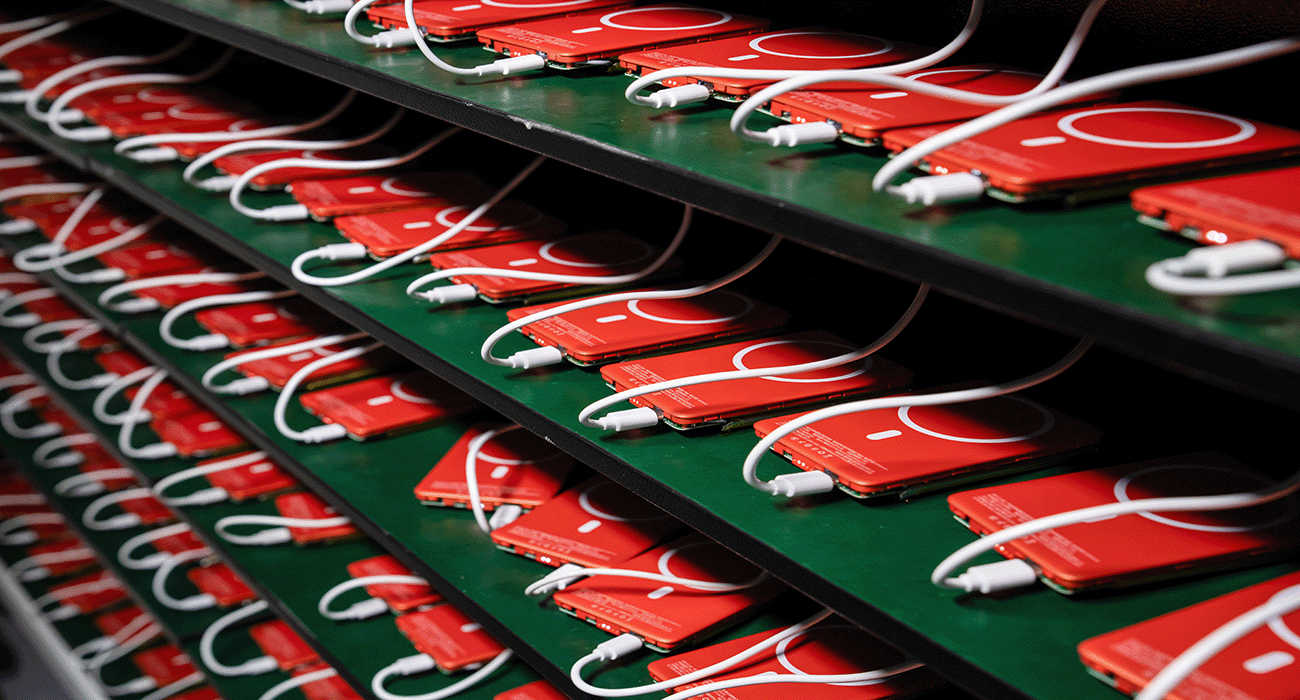
It starts with the cell. We refuse to use “Grey Market” cells. Grade-A Only: We source exclusively Grade-A, fresh-production cells(Only recently produced). Every incoming batch undergoes a High-Temp Aging Test (45°C for 48 hours). If a single cell swells during this stress test, the entire batch is rejected. Vacuum Baking: Before sealing, we subject the cells to a 24-hour Vacuum Bake to remove every trace of moisture, ensuring the internal water content is < 20ppm.
Layer 2: Customized BMS Logic
Standard off-the-shelf chips aren’t enough. We customize the Battery Management System (BMS) firmware for your specific use case. Conservative Cut-offs: Instead of pushing the battery to its limit, we set the charging cut-off slightly lower. This sacrifices maybe 2% capacity but extends the lifespan and stability significantly.
Layer 3: Proactive DFM

This is where most OEM factories fail. They just build what you draw. The “10% Rule”: When we receive your ID design, our engineers conduct a DFM review. We check: Does this case have enough room? We insist on reserving at least 10% extra volume inside the battery compartment. This “breathing room” accommodates natural expansion, preventing the case from cracking open even after years of use.
Warehouse & Logistics Safety
The danger doesn’t end when the product leaves our factory. The months spent in a shipping container or an Amazon warehouse are critical. Here is how to manage the risk.
1. Implement a “First-In, First-Out (FIFO)” system strictly. For stock older than 6 months, we recommend a “Maintenance Charge” cycle to bring the voltage back to the safe storage level (3.8V).
2. How do you spot a bad unit without opening the box? If a batch measures consistently 2mm thicker than the standard spec, it’s a red flag. The battery inside may be swelling and pushing against the packaging. Quarantine that batch immediately.
3. Crush-Proof Design: Our packaging isn’t just pretty; it’s engineered to pass the 1.2m Drop Test. We use reinforced inner trays that absorb shock, preventing physical impact from damaging the soft pouch cells during rough transit. Documentation: Every shipment comes with valid UN38.3 and MSDS reports, ensuring your goods don’t get stuck at customs or rejected by air freight carriers under IATA PI965 regulations.
Conclusion
Battery swelling is the “litmus test” for a power bank brand. It separates the short-term players from the long-term leaders.
You can save a few cents on B-grade cells today, but you will pay for it tomorrow in returns, bad reviews, and lost sleep. At Akhxin, we choose the harder path: rigorous screening, conservative engineering, and uncompromising safety standards.
Don’t let a swollen battery pop your brand’s bubble. Partner with a manufacturer who cares about your reputation as much as you do.


